Review
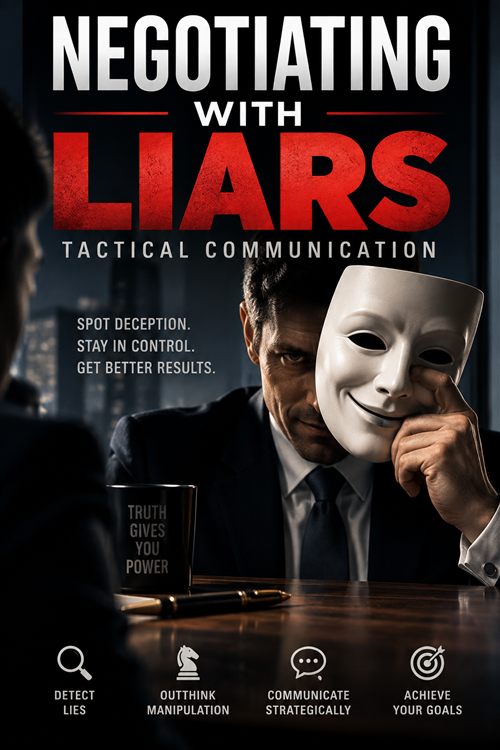
Negotiating with Liars: Tactical Communication
Rating: ★★★★★ — A field manual for one of the most uncomfortable conversations you'll ever have
There's a particular kind of dread that comes from sitting across a table from someone whose story just doesn't add up — a vendor, a colleague, a teenager, a partner — and realizing you have no idea what to do next. Accuse them, and you look paranoid if you're wrong and combative if you're right. Say nothing, and you walk away knowing less than you should. Negotiating with Liars exists precisely for that moment, and it delivers on its promise with a rare combination of intellectual rigor and genuine warmth.
What This Book Actually Is
Let's clear up what this book is not first, because the title invites some understandable skepticism. This isn't a pop-psychology checklist of "5 signs someone is lying" dressed up with pseudoscience about crossed arms and shifty eyes. The author is refreshingly upfront, early and often, that most of those popular "tells" don't hold up under real research — and then spends the rest of the book building something sturdier in their place: a genuine framework for steering a conversation toward the truth, built on psychology, negotiation theory, and an unusual amount of common sense.
The central metaphor — steering rather than confronting — sets the tone for everything that follows. Instead of treating a difficult conversation as an interrogation to win, the book treats it as something you actively shape: through baseline-setting, strategic questioning, silence, and what the author calls "golden bridges" — giving someone a real, face-saving reason to choose honesty over a lie. It's a genuinely different mental model than most books in this space, and it's the reason the tactics inside feel usable rather than manipulative.
What Sets It Apart
It's built on an actual moral spine, not just tactics. Many books in the negotiation and persuasion genre treat ethics as an afterthought — a disclaimer paragraph before getting to "the good stuff." This one doesn't. From the first chapter, the book is explicit that these techniques exist in service of getting to the truth fairly, never to trap, coerce, or manipulate someone who's vulnerable. That framing isn't decorative — it shapes which techniques even make it into the book, and it's a genuinely reassuring thread to feel running underneath every chapter.
It respects the difference between "nervous" and "lying." This is, in my view, the book's single best contribution. An entire chapter is devoted to distinguishing stress from deception — because an honest, simply anxious person and a practiced liar can look almost identical from the outside, and conflating the two is how well-meaning people end up misjudging perfectly innocent conversations. Most books in this genre skip this distinction entirely. This one builds its whole method around it.
The tactics are concrete enough to use tomorrow. Baseline-setting, funnel questioning, tactical silence, mirroring and labeling, the "golden bridge" — every technique comes with a real scripted example, not just an abstract principle. You finish a chapter knowing exactly what sentence to say and when. That's rarer than it should be in this category, where a lot of books stay comfortably theoretical.
It knows its own limits. The book never oversells itself into "you'll become a human lie detector." Each chapter is calibrated, careful, and honest about what body language and questioning technique can and can't tell you — which, paradoxically, is exactly what makes the parts it is confident about feel trustworthy.
Who This Book Is For
You don't need to be a hostage negotiator or HR investigator to get real value here. If you manage people, negotiate deals, interview candidates, co-parent, or simply have relationships with other human beings capable of shading the truth under pressure — which is to say, everyone — there's a real, practical skill in this book waiting for you. Managers will find the chapters on workplace pushback and stonewalling immediately applicable. Parents will recognize the teenager-and-curfew scenarios instantly. Anyone who negotiates anything — a salary, a contract, a price — will walk away with tools they can use in the very next conversation.
A Few Honest Notes
This isn't a light, breezy read — it's closer to a field manual than a beach book, and it rewards being worked through deliberately rather than skimmed. If you're looking for a quick listicle of "lie-detecting tricks," this will feel denser than you expected. That density is also its strength: nothing here is filler, and the book resists the temptation to pad itself with recycled pop-psychology claims just to sound more dramatic.
The book is also unusually candid that some of the most trusted "tells" — eye contact, in particular — are mostly myths. If you came in hoping to have your existing beliefs about body language confirmed, be ready to have a few of them gently corrected instead. It's a better book for it, but worth knowing going in.
The Bottom Line
Negotiating with Liars succeeds at something genuinely difficult: it takes a subject that could easily tip into either dry academic theory or manipulative pop-psychology, and instead delivers a careful, usable, ethically grounded framework for one of the most universally uncomfortable situations people face. The writing is clear and direct, the examples are vivid enough to stick, and the underlying respect for both the truth and the other person in the conversation comes through on every page.
If you've ever sat across from someone and felt that quiet, uneasy sense that something isn't adding up — and wished you knew what to actually do about it — this book hands you a real answer, not just reassurance.
Recommended for: negotiators, managers, HR professionals, parents, investigators, salespeople, and anyone who wants to handle a hard conversation with more skill and less guesswork.
![[PLACEHOLDER] What Micro-Expressions Reveal — book cover](https://liedetectorr.com/wp-content/themes/rapportly/assets/images/covers/cover-2.svg)
![[PLACEHOLDER] The Interrogator's Handbook — book cover](https://liedetectorr.com/wp-content/themes/rapportly/assets/images/covers/cover-3.svg)
![[PLACEHOLDER] The Digital Lie — book cover](https://liedetectorr.com/wp-content/themes/rapportly/assets/images/covers/cover-4.svg)
![[PLACEHOLDER] Your Child's Little Lies — book cover](https://liedetectorr.com/wp-content/themes/rapportly/assets/images/covers/cover-5.svg)